
Social Security
Timing Your Social Security Decision
Getting it wrong costs a typical household $182,370 (NBER, 2022). Here’s how to get every dollar you’ve earned, make the check you get go further, and protect it.
Free. 3 questions, about 1 minute. We ask for your email and mobile to send your results, and nobody will call you. Rules checked against SSA.gov.
Lost a husband or wife? Survivor benefits, step by step →

Start here
Which of these is you?
Four situations cover most people we hear from. Each one starts with the rule and ends with your next step.

“I’m deciding when to claim”
One decision sets your check for life. See your check at 62, at your full retirement age and at 70, and when waiting pays off. Married? Two claims, timed together, can change what the survivor gets later.

“I already get Social Security”
Your 2027 raise in dollars after Medicare takes its share, the days your check arrives, and money you may qualify for without knowing it.

“My benefit may depend on a husband, wife or ex”
A spouse, ex-spouse or survivor benefit can be bigger than your own. It’s paid instead of your own benefit, not on top of it, so ask Social Security to compare. An ex-spouse generally needs a marriage of at least 10 years.
Spousal benefits, married or divorced → Survivor benefits, step by step → How couples time two claims →

“I’m helping a parent with their benefits”
Their payment dates, the letters worth opening first, the scam calls to watch for, and how a family member can be named to manage the check.
What their letters mean → Spot the raise scams → Managing someone’s check →
From The Social Security Playbook
The 7 decisions that set your check
Rules don’t decide how much you get. Decisions do. Already collecting? Four of the seven are still in front of you.
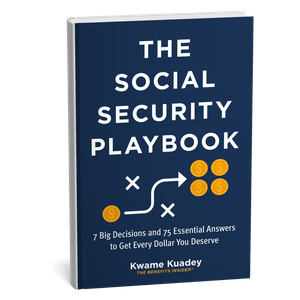 The Social Security Playbook7 Big Decisions and 75 Essential Answers Get the book →
When to claim
62, your full retirement age, or 70. The one choice you can’t easily undo.
Working while on benefits
The earnings test, what income counts, and how withheld money comes back to you.
Spousal and ex-spousal benefits
Up to half of a spouse’s benefit, the 10-year rule for ex-spouses, and how couples time two claims.
Survivor strategies
What a widow or widower can get, and why the order you claim in matters.
Disability vs. early retirement
If your health is failing before full retirement age, why the order matters.
Taxes and withholding
How much of your benefit is taxed, and how to have tax taken out so April isn’t a surprise.
Medicare timing
Signing up for Medicare on time, and how the Part B premium comes out of your check.
Not sure which decision is yours? Take the 7-minute diagnostic from the book →

Payment days
When is my check coming?
Your payment day depends on your birthday, and on when you started. Pick yours to see your next three dates.
See all 2027 dates → How much is my 2027 check? → Why SSI pays early in December →
Your mail
Got a letter from Social Security?
Open it the day it comes. Some letters have a deadline, and some change your check. Tap a letter to see what it means and what to do.

Your yearly raise letter (the COLA notice)Online in late November, by mail in December
A one-page notice with your new monthly amount, any deductions, and, if you have Medicare, your premium for the new year. The 2027 raise is 3.6%. Social Security checks go up starting with January 2027 payments. SSI goes up with the payment dated December 31, 2026.
Check these
- Your new amount before deductions: about 3.6% more than this year’s.
- If you have Medicare, the premium taken out. If it’s higher than you expected, ask why. An income surcharge (IRMAA) is one reason; see the next letter.
- Life changes Social Security should know about: tell them if you married or divorced, or if your spouse or ex-spouse died.
What to do: Something wrong? Call Social Security at 1-800-772-1213 (Monday to Friday, 8 a.m. to 7 p.m.). If you disagree with a decision, you can ask for a reconsideration within 60 days of receiving it, on form SSA-561. To read this year’s notice online, up to three weeks before the paper one, create your my Social Security account and choose paperless notices by November 18, 2026.
Sources: SSA: 2027 COLA fact sheet · SSA: cost-of-living adjustment · SSA news release, Oct 14, 2026 · SSA: request reconsideration · checked Nov 14, 2026
An overpayment letter (“we paid you too much”)Two clocks: 30 days and 65 days from the date on the letter
Social Security says it paid you more than it should have and wants the money back. If you do nothing, it keeps 50% of your monthly Social Security benefit, or 10% of an SSI payment, until it’s repaid. (That 50% rate applies to letters sent since April 25, 2025.)
Check these
- The amount, the months it covers and the reason. Is it right?
- Whether it was your fault. If it wasn’t, and repaying would be a hardship or unfair, you can ask Social Security to forgive it (a waiver).
- The payment-options page, with the Remittance ID you need to pay online.
Deadline: Ask for a waiver or an appeal within 30 days of the date on the letter, and nothing is taken until Social Security decides. To keep your right to appeal at all, file within 65 days of the date on the letter. A waiver can be asked for at any time.
What to do: Disagree with the amount? Appeal on form SSA-561. It wasn’t your fault and you can’t afford it? Ask for a waiver on form SSA-632. You agree, but 50% is too much? Ask for a smaller monthly amount on form SSA-634. Questions or appeals: 1-800-772-1213. To repay or set up a payment plan: 1-855-807-8807.
Sources: SSA: resolve an overpayment · SSA: ask us to waive an overpayment · 20 CFR 404.909 (appeal deadline) · SSA POMS GN 02250.001 (waiver at any time) · checked Nov 14, 2026
A letter saying your Medicare premium is higher because of your income (IRMAA)Usually in November; the amount also shows on your raise letter
Medicare charges more for Part B and Part D when income is over a set line. Social Security decides using your tax return from two years earlier, so 2027 premiums are based on your 2025 return (or 2024, if 2025 isn’t on file yet).
Check these
- The income figure and the tax year it came from.
- Whether your income has dropped since then because of a life-changing event (the list is below).
Deadline: To appeal, file within 65 days of the date on the letter. For a life-changing event, ask as soon as you can: a lower premium generally starts January 1 of the year you ask.
What to do: Your income dropped because you stopped or cut back work, married, divorced, lost a spouse, lost income-producing property, lost or had a pension plan cut, or got a settlement from an employer’s closure? Ask for a new decision on form SSA-44, with proof. That isn’t an appeal. If the IRS figure is wrong, fix it with the IRS first; for an amended return, call 1-800-772-1213. Disagree for another reason? Appeal on form SSA-561.
Sources: SSA: lower your IRMAA · SSA: Medicare premiums · 20 CFR 418.1205 (life-changing events) · SSA POMS HI 01140.001 (appeals) · checked Nov 14, 2026
Work out my appeal deadline → Will I pay the income surcharge? → Check my 2027 raise →
Free tools
Run your own numbers
Every tool is free. Your answers stay on your device; we only receive your email, your mobile number and a one-line summary. Nobody will call you.

“No panic. No politics. Just clarity.”Every rule on these pages is checked against SSA.gov and Social Security’s own handbooks, with the date we last checked it. Author of The Social Security Playbook.
Why I built Benefits Insider → The 75-video library →
 The Social Security PlaybookGet the book →